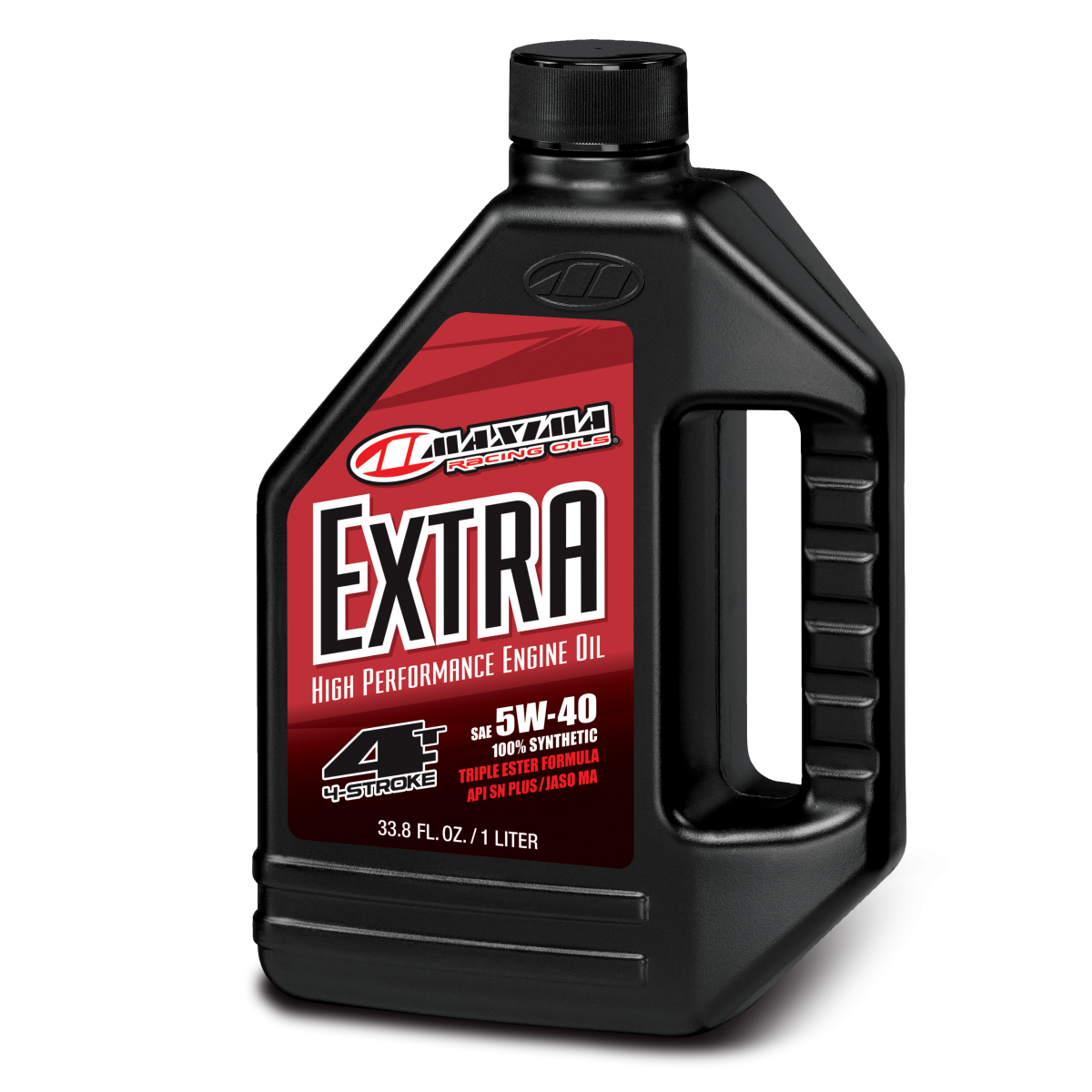
If you ride a four-stroke KTM, your manual almost certainly says SAE 10W-50. Not a brand — a viscosity grade. And that is the whole point: you can choose the oil, as long as it meets that grade and the standards. Maxima Pro Plus+ 10W-50 is a full-synthetic, ester-fortified four-stroke oil that meets and exceeds it — and in the US, where it comes from, it is a completely ordinary sight in KTM, Husqvarna and GasGas paddocks.
In this article you will find what KTM actually specifies, the real numbers from Maxima's technical data sheet (not marketing lines), a capacity table by model, and a clear answer on whether you have to run the original.
What KTM really specifies — a viscosity, not a brand
This is the misunderstanding I meet most often in the workshop. The KTM manual and the manufacturer's official table list a specific viscosity requirement and a recommended product alongside it. The requirement is binding; the trade name is not — that is a contractual partner's recommendation.
| KTM model | Specified viscosity | Oil capacity | Pro Plus+ 10W-50? |
|---|---|---|---|
| 250 / 350 SX-F, XC-F | SAE 10W-50 | 1.0 l | yes — exact grade |
| 450 / 500 SX-F, XC-F, EXC-F | SAE 10W-50 | 1.2 l | yes — exact grade |
| 790 / 890 DUKE, ADVENTURE | SAE 10W-50 | 2.8 l | yes — exact grade |
| 690 ENDURO R, SMC R | SAE 15W-50 | 1.7 l | no — go for a 15W-50 |
| 390 DUKE, RC 390, 390 ADVENTURE | SAE 15W-50 | 1.7 l | no — go for a 15W-50 |
Source: KTM's official capacity and specification table. Capacities are for a normal oil change including the filter and vary by model year — always check the figure in your own manual and verify the level through the sight glass after filling.
The same goes for Husqvarna and GasGas. Their motocross and enduro models are built on the same engineering as KTM and carry the same 10W-50 requirement — so everything in this article applies to FC, FE, TC, EC and MC four-strokes too.
What is in the bottle — Pro Plus+ 10W-50 without the marketing
Maxima Racing Oils is a Californian brand founded in 1979 that has spent its whole life making lubricants for motorsport. Pro Plus+ is its flagship four-stroke line, described by the manufacturer as a 100 % synthetic, ester-fortified oil for all air- and water-cooled four-strokes — for racing and everyday use alike.
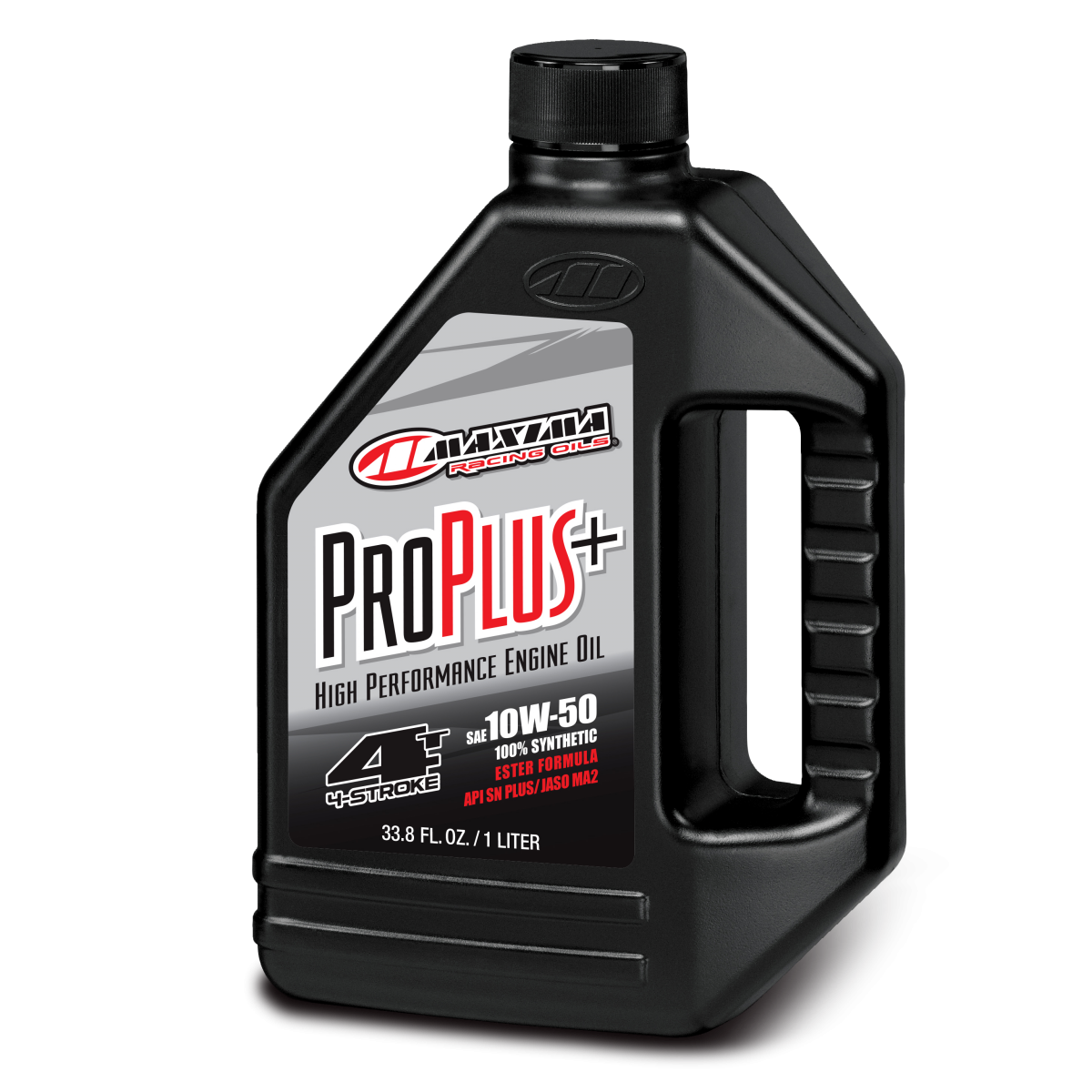
What actually holds up is shown by the numbers from the technical data sheet. These are the official figures for the whole Pro Plus+ line — the 10W-50 column is yours:
| Property | 10W-30 | 10W-40 | 10W-50 | 20W-50 |
|---|---|---|---|---|
| Viscosity @ 40 °C (cSt) | 65.6 | 89.3 | 127.9 | 133.4 |
| Viscosity @ 100 °C (cSt) | 10.8 | 14.2 | 18.5 | 18.6 |
| Viscosity index | 156 | 165 | 163 | 157 |
| Flash point (°C) | 205 | 207 | 222 | 218 |
| Pour point (°C) | −42 | −36 | −42 | −36 |
| Density @ 15 °C (g/ml) | 0.866 | 0.866 | 0.856 | 0.861 |
Source: Maxima Pro Plus+ technical data sheet (ASTM D445, D2270, D92, D97, D4052).
What those numbers mean inside the engine
- 18.5 cSt at 100 °C — that is the film thickness when it counts: at operating temperature and full throttle. It is why KTM specifies a fifty rather than a forty for high-revving four-strokes.
- Viscosity index 163 — a high number means the oil thins less with heat. A motocross engine in hot sand runs its oil far hotter than a trail ride does, and an index of 163 says the film will still be there when you need it.
- Flash point 222 °C — the highest in the Pro Plus+ line. In practice that means lower volatility: less oil lost up the stack and less thickening from boiled-off light fractions.
- Pour point −42 °C — a cold start in winter is no problem, even for an enduro bike left outside overnight.
- Ester in the base — ester oils cling polarly to metal, so the film stays on the walls even after the engine is shut down. And the first seconds after a start are what wears an engine most.
Wet clutch: JASO MA2 is not a spare sticker
A motorcycle with a wet clutch runs one oil circuit for the engine, the gearbox and the clutch plates. Car oils often carry friction modifiers for fuel economy — and those cause exactly what you fear: the clutch slipping under full throttle.
JASO MA2 is the standard that tests an oil's friction behaviour directly on clutch plates. Per the manufacturer, Pro Plus+ exceeds it, along with API SN PLUS — the American standard that also covers low-speed pre-ignition (LSPI) protection and engine cleanliness.
In practice that means a sharp, repeatable clutch bite even when the engine is cooked after twenty minutes in deep sand. And the second thing I see when stripping engines: an oil with active surface chemistry keeps the engine clean inside — more on that in Why I put Maxima in engines.
What "OEM approved" on the label means
On the Pro Plus+ packaging you will find a list of motorcycle manufacturers the oil is intended for: Honda, Yamaha, Suzuki, Kawasaki, KTM, Husqvarna, BMW and Triumph. Read it correctly — it tells you the oil meets the specifications these brands require of a four-stroke motorcycle oil (viscosity grade, JASO MA/MA2, API), not that an authorised dealer would enter it in your service book in place of the original.
And that is the point: once the warranty is over, what matters is whether the oil meets the specification. That is when you pick on quality rather than on who has a contract with whom.
How often to change the oil in a KTM
The interval is in your model's service schedule and differs between motocross and street use by an order of magnitude. A few rules that always hold:
- Motocross and enduro: count engine hours, not kilometres. A race engine holding one litre of oil and revving past 12,000 rpm loads that oil incomparably harder than a road bike does.
- Change the oil filter with the oil, not every second time. A KTM has two screens plus the filter — check all of them at every change.
- After a new piston or a rebuild, bring the first change forward. For the break-in itself there is Maxima Break In — more in Breaking in a new piston and engine.
- A race means fresh oil. Oil costing a few tens of euros is the cheapest insurance for an engine whose rebuild costs a hundred times more.
Which pack size to buy
We stock Pro Plus+ 10W-50 in three sizes — pick by how many bikes you service:
| Pack | For whom | Covers |
|---|---|---|
| 1 litre | one bike, one change | 250/350 SX-F (1.0 l) |
| 3.8 litres | a full season or two bikes | 3 changes on a 450/500 (1.2 l) |
| 60 litres | a workshop, team or club | ~50 changes |
A 790/890 Duke or Adventure takes 2.8 litres — there the 3.8 l pack makes sense straight away, with the rest left over for topping up.
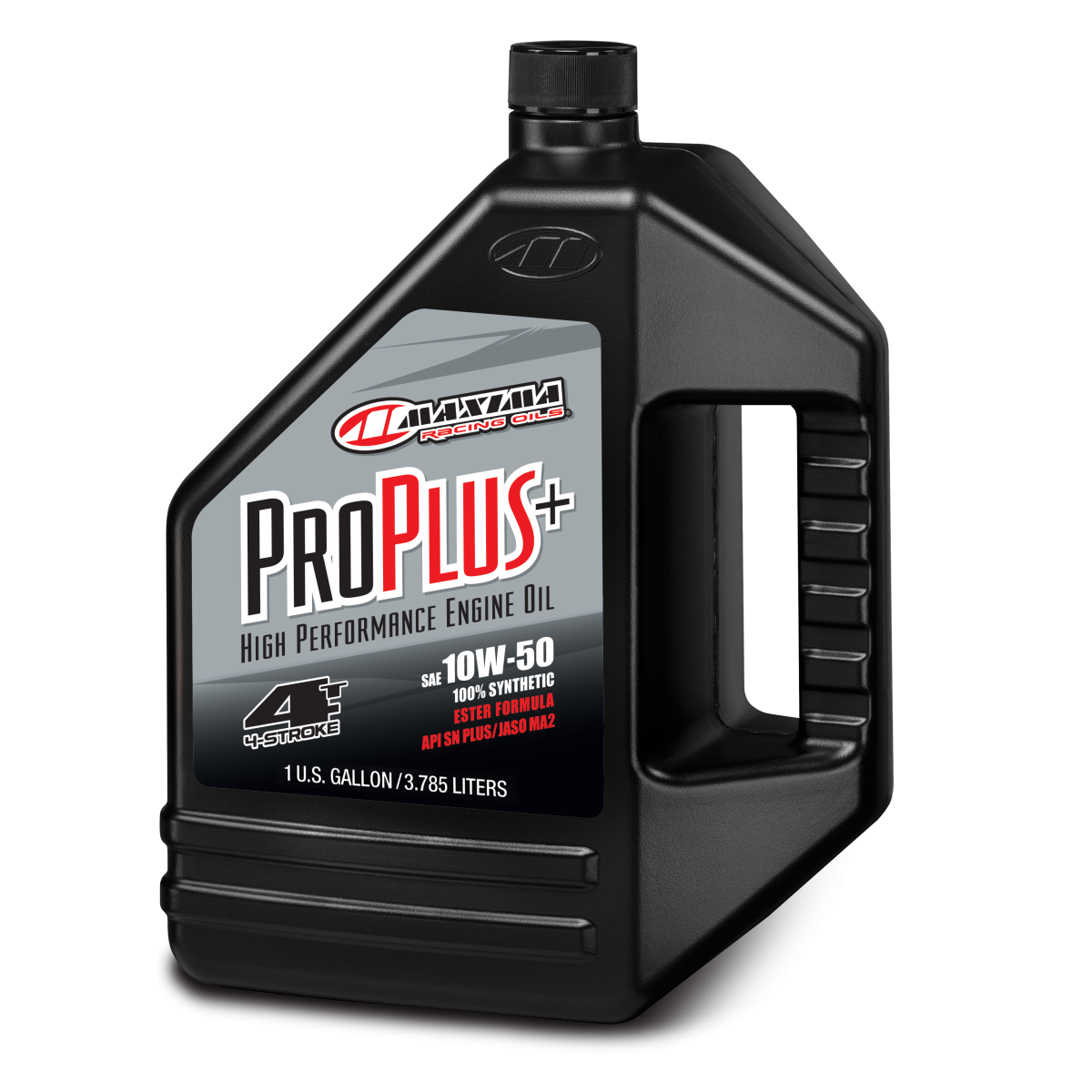
Pro Plus+ versus the original oil — how to compare fairly
I am not here to run down the oil your dealer recommended — it is a good product and it has its place. I will only tell you how to compare two oils honestly, so you can decide for yourself:
- Viscosity grade — it has to match the manual. 10W-50 against 10W-50.
- Standards — JASO MA2 is mandatory with a wet clutch, API SN PLUS is today's benchmark for cleanliness and protection.
- Viscosity at 100 °C and viscosity index — the higher the index, the more stable the film across temperatures.
- Flash point — a higher figure means lower volatility and less topping up.
- Base oil — a full synthetic with ester is a different league from a semi-synthetic, even at the same grade on the label.
All of those numbers for Pro Plus+ are in the table above. Compare them against anything else's data sheet and decide on the figures, not the advertising.
What else belongs with an oil change
With the bike already on the stand, it pays to do the service properly:
- Oil filter and screens — mandatory on a KTM; check them for metal particles.
- Air filter — the cheapest insurance for a cylinder. For foam filters, Air Filter Cleaner and FFT oil, or the filter service kit.
- Chain — clean and lube it while the bike is apart. For motocross the Clean-Up + Chain Guard + SC1 kit, for the road the Chain Wax version.
- Coolant — Coolanol or Cool-Aide if you have not changed it in over two seasons.
Frequently asked questions
What oil does KTM specify for its four-strokes?
For the 250/350/450/500 SX-F, XC-F and EXC-F as well as the 790 and 890 ranges it is SAE 10W-50 (the manual allows 10W-60 for harsh use). The 390 and 690 ranges call for SAE 15W-50. No brand is specified — the grade and the standards decide.
Is Maxima Pro Plus+ 10W-50 suitable for a KTM?
Yes. It is a full-synthetic ester four-stroke oil in SAE 10W-50 that, per the manufacturer, exceeds API SN PLUS and JASO MA2 — exactly what KTM asks for.
Will I void the warranty without the original?
Under warranty, stick to the service book and the authorised dealer — it is about documenting the service. After that you choose the brand and meeting the specification is what counts.
How much oil goes into a KTM 350 SX-F?
Per KTM's official table, 1.0 l for the 250 and 350 SX-F/XC-F and 1.2 l for the 450 and 500. Older model years list 1.10–1.20 l. Always check your year and verify the level through the sight glass.
What is the difference between 10W-50 and 10W-40?
At operating temperature the fifty is thicker — 18.5 cSt against 14.2 cSt at 100 °C. The thicker film takes more load, which is exactly the case with high-revving four-strokes. Cold, they are the same (10W grade).
Can I use Pro Plus+ 10W-50 in brands other than KTM?
Yes, in any four-stroke specified at 10W-50 with a wet clutch — Husqvarna, GasGas, Yamaha, Honda, Kawasaki, Suzuki and road bikes with that requirement. The number in the manual always decides.
Where to buy Maxima Pro Plus+ 10W-50
We keep Pro Plus+ 10W-50 in stock in 1 L, 3.8 L and 60 L and ship across Slovakia. We are a workshop, not just a shop — these are the oils we actually pour into the bikes on our own stands, so if you are unsure what your bike needs, get in touch and we will advise.
Take a look at Pro Plus+ 10W-50, the full Maxima range, or read the complete guide to the Maxima brand.