The piston takes on enormous heat and pressure on every stroke, which is why it's one of the engine's limited-life parts. Replacing it in time protects you from a far more expensive engine rebuild — a seized piston can wreck the cylinder, connecting rod and crank all at once.
How often should you replace the piston?
The interval depends on the engine type and how you ride:
- 2-stroke (motocross): roughly every 15–40 engine hours under race use.
- 4-stroke (motocross/enduro): the piston usually lasts 50–100 engine hours, depending on the model and maintenance.
- Recreational riding: intervals tend to be longer, but checking the clearance every season pays off.
How to spot a worn piston
- Dropping compression and harder starting.
- Higher oil consumption or smoking.
- Rattling from the cylinder, especially when cold.
- Visible scoring on the piston skirt, or play in the piston when you check it.
ProX — OEM quality from Japan
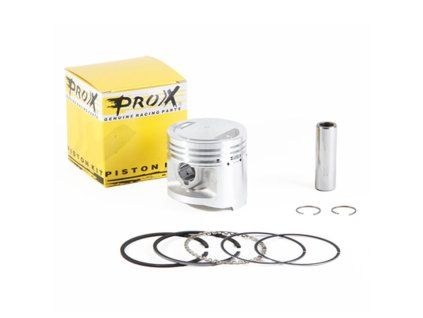
ProX Racing Parts is not a cheap imitation. ProX pistons are forged and cast by the same Japanese suppliers that make the original (OEM) parts for the factories themselves. So you get original quality at a fraction of the price — a complete kit includes the piston, rings, wrist pin and circlips, all exactly within tolerance.
How to pick the right size class — measure the cylinder
Manufacturers (ProX, Vertex, Wössner, Wiseco) supply pistons in precise size classes — often marked with letters A, B, C, D or an oversize in mm (e.g. +0.25, +0.50). The class has to match the actual diameter of your cylinder.
To get it exact, the cylinder is measured with a bore micrometer or a caliper. Measure the diameter at several points (top, middle, bottom and in two axes) — this also reveals the out-of-round and taper of a worn cylinder. From the measured value you pick the correct piston size so you achieve the specified piston-to-cylinder clearance.

With us you'll find the exact size in mm on every piston, so you hit it precisely. Filter by your bike's brand and model and we'll show only the compatible parts in the correct size.
Browse the piston range — besides ProX we also carry Vertex, Wössner and Wiseco. And while you're in the engine, see our article on connecting rods.